A real bookstore, handed to us.Rebuilt end to end and shipped live.
Jack Churchward runs My-Mu, a family bookstore for rare and out-of-print books on the lost continent of Mu. He paid us $747 for a Full Store Fix, so we rebuilt the whole thing on Shopify, then published it live and tested the buying flow ourselves. This is that store, before and after. Don't take our word for it, click through the live one.

A generations-old bookstore, handed to a stranger.
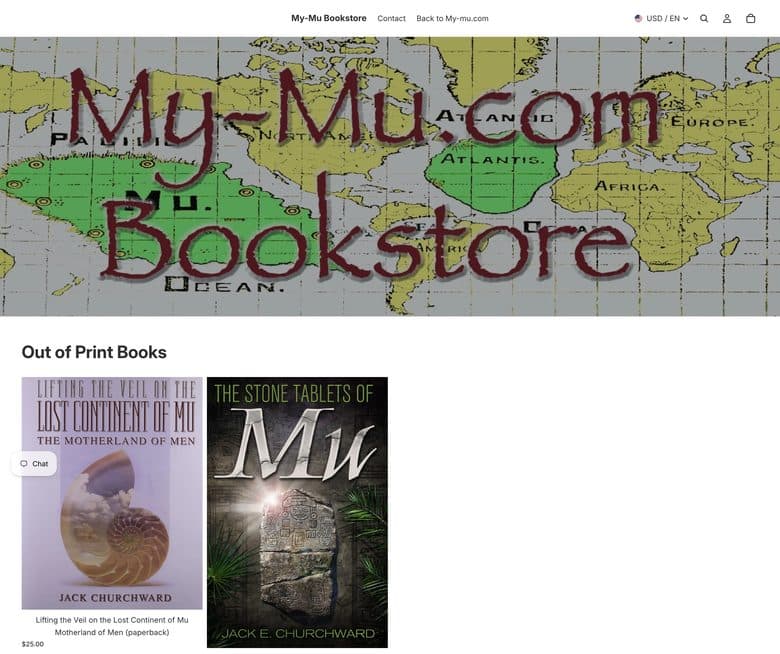
My-Mu is a real bookstore. Jack Churchward sells rare and out-of-print books on the lost continent of Mu, a subject his family has kept alive for generations. When he came to us, the storefront was a clip-art world map with “My-Mu.com Bookstore” word-art, leading with what was out of print instead of what you could actually buy.
He handed us the whole store and paid $747 for a Full Store Fix. We rebuilt it end to end, the same thing you'd be buying, and put it live.
This is our first client rebuild. One store. We'll say one, because it's one.
What we actually did
This is exactly what the $747 Full Store Fix buys, delivered on a real store. The work is the same for any Shopify catalog, books, socks, supplements, apparel.
Rebuilt the whole theme
From a clip-art world map with 'My-Mu.com Bookstore' word-art to an editorial storefront that leads with the Churchward family story and the books you can actually buy, instead of a wall of out-of-print notices.
Per-page SEO across the catalog
Unique titles and meta descriptions written for the products, a malformed product URL fixed, and format labels pulled out of the titles, so each page tells search engines exactly what it is.
Valid Product + Book schema on every product
Structured data so search engines can read each listing as a real book, with title, author, and format. This one is checkable: run any product through Google's own Rich Results Test yourself.
Rebuilt the product pages
Every page now leads with title, cover, edition, format, price, and exactly what you receive, so a buyer knows what they're getting before they add to cart.
Upscaled the low-res covers
The old cover scans were small and soft. We upscaled them so the books look like something worth buying, not a scan of a scan.
Published it live and smoke-tested the buying flow
Not a mockup and not a PDF. We shipped it to my-mu-2.myshopify.com and walked the checkout end to end ourselves.
Don't take our word for it. Click the store.
Open it in a new tab and poke around. Then run any product through Google's Rich Results Test and watch the schema pass. Nothing here is a screenshot we can dress up.
See My-Mu live →This is build-quality proof. We rebuilt it and shipped it live, and you can check every bit of it. It is one store and it is early, so we are not going to quote you revenue, traffic, or rankings we cannot yet back up. When there is real data, it goes here, whichever way it lands.
We proved the engine on our own store first.
Kevin Builds Brands is new. So before we ever asked anyone to trust us with their store, we pointed the same audit-and-fix engine at the one store we have every right to take apart, Kevin's own brand. This is how we knew the method worked before Jack handed us My-Mu.

Thick Thigh Tribe, built to $910K on $0 ads.
Kevin struck out on watches, a beard kit, and sunglasses before Thick Thigh Tribe hit. He built that plus-size sock brand, his own, to roughly $910K in cumulative gross revenue across four channels (2022-2025) on $0 in paid ad spend. A real, running store with real orders. That made it the honest place to prove what the audit actually does, before charging anyone.
What the audit found
The tool reads inside the store through Shopify's Admin API, so these are the store's own numbers, not a guess from the outside.
An audit is only as honest as the data behind it. The tool first saw 100 products and called it done. The real number was 234. Reading all of it means every finding here covers the whole store, not a lucky corner of it.
Without them, Google guesses or skips the page, so people searching for exactly what you sell never find you. 184 of 234 products were effectively invisible to search. That is free traffic walking past the door every day.
A shopper who lands on something they cannot buy hits a dead end. It burns the click, dents trust, and can show as available when it is not. Empty pages quietly leak both traffic and credibility.
New customers are the expensive ones to win. When almost no one comes back, the store is refilling a leaky bucket, paying again and again to find new buyers instead of selling more to the ones it already earned. This is one of the biggest levers on long-term profit.
What we fixed
This is the difference between a PDF and a result. The tool does not just flag the problem, it writes the fix into the store.
Product imagery, 44 images
Products were missing the side and back color shots that help a shopper commit. The tool pushed the missing images to the correct product page across 43 products, automated, in minutes, then verified each one by re-reading the store.
| Product | Before | After |
|---|---|---|
| Midnight Embrace | 2 | 3 |
| Pumpkin Spice | 1 | 2 |
| Spectrum Stride | 1 | 2 |
| All American Stripes | 3 | 4 |
| Rainbow Stripes | 2 | 4 |
Online, the photos do the selling. A shopper cannot touch the product, so every extra angle, especially the detail shots, removes a reason to hesitate at the exact moment they decide. A missing image is a missing reason to say yes.
SEO, 50 products
The audit found 184 products with no SEO title or meta description. We wrote both for all 50 products in the solids and stripes collections, in the brand voice, every title inside Google's 60-character limit and every description inside 155.
Verified store-wide: the missing-SEO count dropped by exactly 50 right after the write.
Those 50 products now tell Google exactly what they are and who they are for, so a search for plus size thigh-high socks has something to land on. Written once, working every day after, with no ad spend behind it.
Catalog cleanup
The audit separates genuinely out-of-stock products from print-on-demand items and gift cards, which sit at zero by design and still sell. Of the 21 genuinely out-of-stock products, we unpublished 6 discontinued ones. The rest are sock colorways kept live for restock.
Pulling dead pages tightens the catalog so every click lands on something a shopper can actually buy, and stops the store from showing items it can no longer sell. The care here is knowing what not to touch: the print-on-demand products that read as zero but still ship were left exactly where they were.
Can AI find you?
Google AI Overviews and shopping assistants now answer questions before anyone clicks. We check whether a store is built to be read and cited, using what is actually in the page, not a guess.
- Product schema — AI engines can read the product, price, and availability
- AI crawlers allowed — GPTBot, ClaudeBot, Perplexity, Google-Extended, CCBot
- Product descriptions — 216 of 227 products have real text to extract
- Image alt text — 226 of 226 products, fixed from 52
- FAQ schema — now live on product pages and rolling out across the catalog nightly
- Ratings schema — not yet, worth adding once reviews are wired in
Image alt text went from 52 of 226 products to all 226. Alt text is what screen readers and multimodal AI use to understand a photo. The tool wrote a factual description for every image that was missing one, then we re-ran the check and watched the number move. We then built FAQ schema in too, which now renders on product pages and keeps rolling out across the catalog automatically. Ratings schema is the next one still open.
What we are still measuring
We are not going to tell you these fixes lifted revenue, on either store, because we do not have the data yet and we will not invent it. Better imagery, real SEO, valid schema, and a clean catalog are understood levers, but understanding a lever is not the same as proving it moved for this store.
We are tracking product-page conversion and repeat rate over the coming weeks and will post the numbers here when the window is real, whichever way they land.
Your store, rebuilt the same way.
Done by me.
You've seen a real store rebuilt end to end and shipped live. Hand me yours and I do the same, you approve every step. From $747, scoped with you. Talk first, pay last.
Not ready to hand it over? Tear it down free first →